
LED Bird
Diverterfor Power Lines
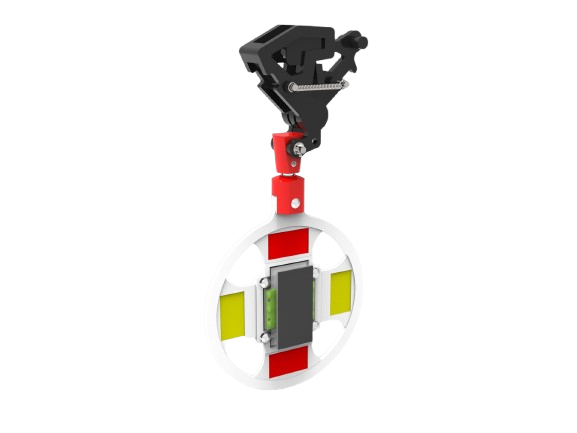
Solar-powered, 6-LED blinking marker with auto day/night switching. Designed for night migration routes, fog corridors and high-risk transmission spans across India.
6 LEDs per Face
100+ Hour Battery
Auto Day/Night
Solar Charged
——The Problem
Why Passive Markers
Fail at Night
Most bird-wire collisions occur between dusk and dawn — the exact window when passive retroreflective and glow-in-dark markers are least effective. India’s power lines cross critical nocturnal migration routes, wetlands and fog-prone river valleys where standard non-LED diverters provide insufficient protection.
The Night Visibility Gap
Retroreflective stickers require an external light source to function. In open-terrain power line corridors — away from streetlights or vehicle headlamps — there is effectively no light to reflect. Glow-in-dark flappers provide a passive dim glow, but their visible range drops sharply after a few hours of darkness.
60%+ Of Collsion
occur during dawn / dusk / night windows endangered species
The LED Solution
High-intensity blinking LEDs emit their own light — independent of ambient conditions. The PLM/LD-V1 activates automatically at dusk, delivering a powerful blinking signal visible at over 1 km in clear conditions and cutting through fog, dust haze and rain. Birds detect the moving light cue and adjust their flight path before reaching the wire.
1km+ Visiblity
LED blinking range in clear night conditions
——Product Design
Five Features That
Define the PLM/LD-V1
01
☀️
Vertical Solar Charging
Solar cells are mounted vertically
Solar cells are mounted vertically — a deliberate engineering choice. Horizontal panels accumulate dust rapidly in India’s dry seasons, slashing charging efficiency. Vertical orientation receives sunlight from all angles throughout the day and sheds dust naturally, maintaining consistent charging output across seasons without cleaning maintenance.
Operational cost: zero
02
🔆
Auto Day/Night Sensor
An integrated ambient light sensor continuously monitors daylight levels. LEDs activate automatically at dusk and deactivate at sunrise — no manual intervention required, ever. This smart switching conserves the 100+ hour battery reserve for nighttime use only, and eliminates any light pollution during daylight hours when LEDs provide no additional benefit over passive stickers.
12,000 mm² glow area per face
03
🔦
6 High-Intensity Blinking LEDs
Six high-intensity LEDs are arrayed symmetrically on each face of the circular flapper. The blinking pattern — rather than a steady light — triggers a stronger avoidance response in birds, which are highly sensitive to movement and intermittent light cues. The dual-face LED layout ensures the warning signal is visible regardless of which direction a bird approaches from.
5,500 mm² retro area per face
04
🌧️
Sealed Weatherproof Electronics
All electronic components — battery, LED module, sensor and control circuit — are housed in a fully sealed, weather-resistant enclosure. The design is rated for continuous outdoor exposure including monsoon rain, coastal salt spray and dust. No maintenance access to electronics is required or possible under normal operating conditions, eliminating the risk of water ingress from service tampering.
Wind-driven · pendulum stabilised
05
🔄
360° Rotation + Glow Backup
The LED module is mounted on the same 360° rotating swivel used in the passive Non-LED model. The spinning motion provides an additional kinetic warning signal during the day and amplifies LED visibility at night by creating a sweeping light arc. The flapper also retains glow-in-dark and retroreflective materials as a passive backup if battery charge is depleted — providing triple-layer protection.
Fits 5mm–38mm · <350g
——Operating Principle
How the LED
Bird Diverter Works
Three integrated systems work together to deliver round-the-clock bird protection — no manual operation, no power grid connection required.
01
☀️
Daytime Solar Charging
During daylight hours, the vertically mounted solar cells continuously convert sunlight into stored charge. The auto-cutoff sensor deactivates all LEDs during this phase, directing 100% of solar input to battery charging. On a clear day, the system reaches full charge within several hours — providing over 100 hours of nighttime operation from a single full charge cycle. The passive retroreflective stickers provide daytime visibility without any power draw.
AUTO · PASSIVE DAYTIME
02
🌆
Dusk — Automatic LED Activation
As ambient light levels drop below the sensor threshold at dusk, the control circuit automatically activates the 6-LED blinking array on both faces of the circular flapper. The activation is instantaneous — there is no delay window during which the device is dark. The blinking frequency is optimised to maximise bird detection response: fast enough to register as an urgent warning, not so fast it becomes a continuous glow that birds habituate to.
AUTO · SENSOR TRIGGERED
03
🦅
Active Night Bird Warning
With LEDs active, the spinning flapper creates a sweeping blinking arc visible at over 1 km in clear night conditions. Birds detect the intermittent light source at sufficient distance to react and change flight direction — well before reaching the conductor. The combined effect of blinking LEDs, 360° rotation, and the physical presence of the flapper disc creates a multi-cue warning that works across species including large waterbirds, raptors, and migratory flocks.
ACTIVE · 1KM+ VISIBILITY
—-Technical Data
PLM/LD-V1
Specifications
| Compliance Standard | CEA Technical Specification for Bird Flight Diverters Central Electricity Authority, Government of India |
| LEDs per Face | 6 high-intensity blinking LEDs |
| Battery Runtime | 100+ hours continuous blinkingFrom a single full charge cycle |
| Daytime Operation | Auto-cutoff via ambient light sensor |
| Solar Charging | Vertically positioned cellsOmnidirectional / dust-resistant orientation |
| Electronics | Sealed weather-resistant system |
| Working Temperature | −20°C to 100°C |
| Conductor Clamp Size | Universal — 5mm to 38mm diameter |
| Flapper Diameter | 180 mm |
| Flapper Thickness | 5 mm |
| Retro Area per Face | +4,200 mm²Multicolour retroreflective stickers |
| Weight | Less than 500 grams |
| Installation Method | Hot-stick installation — no line shutdown required |
| Compatible Lines | LT, 11kV, 33kV, 66kV, 132kV, 220kV, 400kV |
What These Numbers Mean
6 LEDs per face:
dual-face layout means the blinking signal is visible from all approach angles — front, side and rear. No blind approach direction exists.
100+ hour runtime:
even in three consecutive overcast days with minimal solar charging, the battery reserve sustains full night operation without interruption
−20°C to 100°C:
tested for Himalayan high-altitude winter lines and Rajasthan summer transmission routes in the same product — no seasonal variants needed.
<550g weight
within the weight limit specified by CEA for bird flight diverters on conductor spans. No conductor sag or tension impact at CEA-specified installation spacing.
4,200 mm² retro + 8,500 mm² glow per face:
passive systems remain fully functional even at zero battery charge — the LED model is never “off,” only at reduced visibility mode.
CEA COMPLIANT
MADE IN INDIA
TEST CERT
UV STABLE
Use Cases
Where LED Diverters
Are Essential
The LED bird diverter is specified for power line spans where passive markers alone are insufficient — typically where bird flight occurs at night, in reduced visibility conditions, or at high altitude where ambient light levels are consistently low.
APPLICATION 01
✈️
Airport-Vicinity Power Lines
Power infrastructure within airport influence zones must meet active lighting requirements. Lines crossing approach paths and taxi corridors near airports carry high bird traffic — particularly large waders and waterfowl attracted to airport grasslands — and require the visibility range that only LED blinking delivers.
Required: active blinking visible to pilots and birds during low-visibility approaches
APPLICATION 02
🌫️
Fog-Prone River Plains & Valleys
North Indian river plains — including Ganga, Yamuna, Brahmaputra and their tributaries — experience dense winter fog for weeks at a time. Passive retroreflective markers become almost invisible in heavy fog. High-intensity LEDs cut through fog and rain far more effectively, maintaining bird warning capability during the winter months when migratory species are at peak density.
Fog penetration: LED blinking visible where retroreflective fails
APPLICATION 03
⚡
HV & EHV Transmission Corridors
High-voltage lines (66kV and above) cross longer spans at greater heights and often traverse open terrain with minimal ambient light. Long cross-country HV transmission corridors pass through ecologically sensitive zones where regulatory scrutiny is highest and absolute collision prevention is required to maintain environmental clearances and avoid wildlife-related outages.
Regulatory compliance: EHV spans in eco-sensitive zones require CEA-standard active marking
APPLICATION 04
🦚
Raptor & Crane Hunting Corridors
Eagles, kites, vultures, Sarus Cranes and Demoiselle Cranes are most active and at highest wire-strike risk during dawn and dusk — the transitional periods when passive glow-in-dark markers are exhausted and retroreflective stickers have insufficient ambient light to function. The LED auto-sensor activates at precisely these twilight risk windows.
Dusk/dawn activation: covers peak risk window for raptors and cranes
Why Choose Passive
The Three Practical
Advantages
The passive non-LED bird diverter’s commercial case rests on three clearly quantifiable advantages over active LED alternatives for most deployment scenarios.
Lowest Total Cost
The non-LED model carries a lower unit purchase price than the LED variant, and zero ongoing operational cost. Over a 10-year deployment on a 100km rural distribution line requiring approximately 10,000 units, the cost differential versus LED diverters — purchase price plus maintenance visits avoided — is substantial. For state DISCOM procurement under budget constraints, this makes the passive model the economically rational choice for all spans that do not specifically require active LED marking.
Unit cost + 10-year ops cost = purchase price only
Zero Maintenance
There is nothing to service. No battery to replace when it degrades after 3–5 years. No solar panel to clean when dust accumulates. No electronic circuit to fail or short in monsoon water ingress. No firmware to update. No specialist technician required. The passive diverter’s mechanism — a polymer disc on a stainless steel swivel — has no consumable components. Once installed correctly, it requires no further attention for its entire service life. For utilities managing thousands of kilometres of line, this operational simplicity translates directly into lower total cost of asset management.
No battery · No panel · No circuit · No visits
10+ Year Service Life
UV-stabilised polymer construction and stainless steel hardware resist the full range of Indian climate stressors — UV radiation, monsoon humidity, dust, freeze-thaw cycling at altitude, salt air on coastal lines. The expected field service life exceeds 10 years under normal operating conditions. This compares favourably with active LED diverters, where battery service life of 3–5 years typically triggers the first maintenance cycle and its associated cost. The passive diverter’s extended service life significantly improves whole-life cost per unit of bird protection delivered.
10+ year field life · UV stable · Weatherproof
When to Upgrade to LED
The passive non-LED diverter is the right specification for the majority of Indian power line spans. Upgrade to the LED Blinking Marker (PLM/LD-V1) specifically for spans where bird activity is documented at night or during fog — including nocturnal migration corridor crossings, airport-vicinity lines, fog-prone river plains and spans serving habitats with documented nighttime bird use. Many projects use a mixed specification: passive diverters on the majority of spans, LED on critical crossings.
Common Questions
LED Bird Diverter
Questions
FAQ
Installation, Lifespan & Compliance
These are the most common technical questions we receive from utility engineers, procurement teams and project managers. If your question isn’t covered here, contact our team directly for a detailed technical response. Need a specific answer? Contact our technical team.
Ask a technical question →
The PLM/LD-V1 provides over 100 hours of continuous LED blinking from a single full charge cycle. In practice, this means that even during three consecutive days of heavy cloud cover with minimal solar input, the device maintains full night operation without interruption. The solar charging system is designed to bring the battery to full charge on any day with reasonable sunlight — including partial overcast conditions — maintaining the 100+ hour reserve before the next extended low-light period.
Yes. An integrated ambient light sensor continuously monitors daylight intensity. The LED array deactivates automatically at sunrise and reactivates at dusk — with no manual intervention required. This automatic switching serves two purposes: it conserves battery charge for nighttime operation (when LEDs are needed most), and it eliminates any light pollution during daylight hours. The exact activation threshold is calibrated for Indian twilight conditions across seasons, ensuring the LEDs activate early enough to cover the dusk risk window.
Yes. The PLM/LD-V1 is designed and tested to comply with the Central Electricity Authority (CEA) technical specifications for bird flight diverters issued by the Government of India. We provide full test certificates, compliance documentation and product datasheets with every order — including the documentation required for DISCOM tenders, PGCIL project specifications, Forest Department approvals and environmental clearance submissions.
Yes. All electronic components are housed in a fully sealed, weather-resistant enclosure designed for continuous outdoor exposure. The device operates reliably through monsoon rain, coastal salt spray, dust storms and extreme temperature variation. There are no maintenance access ports that could allow water ingress. The solar cells continue to generate charge even in diffuse monsoon light — at reduced efficiency compared to clear days, but sufficient to maintain the battery at an adequate level for regular night operation throughout the monsoon season.
CEA guidelines recommend spacing of approximately every 10 metres on spans within ecologically sensitive zones including wildlife sanctuaries, Important Bird Areas (IBAs) and wetlands. In the highest-risk locations such as river and lake crossings and active migratory corridors, closer spacing of 5 metres may be appropriate based on avifauna assessment. We provide installation guidance documentation with all bulk orders, including span layout recommendations for different risk categories. Staggered installation across multiple conductors in the same span increases overall effectiveness.
Specify the
LED Diverter
on Your Project
We supply CEA-compliant LED bird diverters to state DISCOMs, transmission utilities, PGCIL contractors, renewable energy developers and Forest Departments across India. Technical datasheets, test certificates and bulk pricing available on request.
CEA test certificates provided with every order
✓Hot-stick installation — no power shutdown needed
✓Bulk pricing from 500 units, fast dispatch from New Delhi
✓Technical support for project specification and layout
✓Government GST invoicing and tender documentation available
Request a Quote
Also Available
Complete Diverter Range
The PLM/LD-V1 is part of a family of three CEA-certified bird diverter products, each optimised for specific deployment conditions.
ACTIVE · SOLAR POWERED
Non-LED Bird Diverter
PLM / NLD-V1
Glow-in-dark flapper, retroreflective stickers, 360° rotation. Zero maintenance, fully passive. Ideal for bulk LT/HT deployments and remote locations without maintenance access.
View Product →
ACTIVE · SOLAR WIND ACTIVATED · HIGH-WIND CORRIDORS
Aero Spin Diverter
PLM / AER-V1
Multi-blade aerodynamic spinner activates in light breeze. Larger visual footprint than disc-type. For desert transmission routes, coastal lines, open ridgeline spans and GIB habitat corridors.
View Product →
Product Comparison
LED vs Non-LED
Bird Diverter
Both products are CEA-certified and share the same mechanical platform. The choice between them depends on the visibility conditions and regulatory requirements of the specific installation span.
| LED Blinking Marker PLM / LD-V1 | Non-LED Marker PLM / NLD-V1 | |
| Daytime visibility | ✓✓ Retroreflective + LED | ✓ Retroreflective only |
| Night visibility | High-intensity LED blinking — 1km+ range | Glow-in-dark only (~150–200m) |
| Fog / reduced visibility | LED penetrates fog and rain effectively | Passive — limited fog penetration |
| Dawn / dusk coverage | Auto sensor activates at dusk precisely | Passive — no active dawn/dusk response |
| Power requirement | Solar (self-contained, no grid needed) | None — fully passive |
| Maintenance requirement | Minimal — sealed electronics | Zero — no moving electronics |
| Weight | Less than 500g | Less than 350g (lighter) |
| Retroreflective area / face | +4,200 mm² | +5,500 mm² (larger passive area) |
| CEA compliance | ✓ Fully compliant | ✓ Fully compliant |
| Ideal for | Night migration, fog, airports, EHV lines, critical zones | Daytime-only risk, rural distribution, bulk LT deployments |
💡
Recommendation: Specify LED diverters (PLM/LD-V1) on any span where birds are active at night, dawn or dusk, or where fog and low visibility are seasonal factors. For daytime-only risk zones and large-scale LT/11kV rural deployments where budget efficiency is the priority, the Non-LED model (PLM/NLD-V1) delivers full CEA compliance at lower cost per unit. Many projects use a mixed specification — LED on critical spans and crossing points, Non-LED elsewhere.